
JOURNAL 001 · OBJECTIVE REVIEW
A Good Poker Decision Can Still Produce a Bad Result
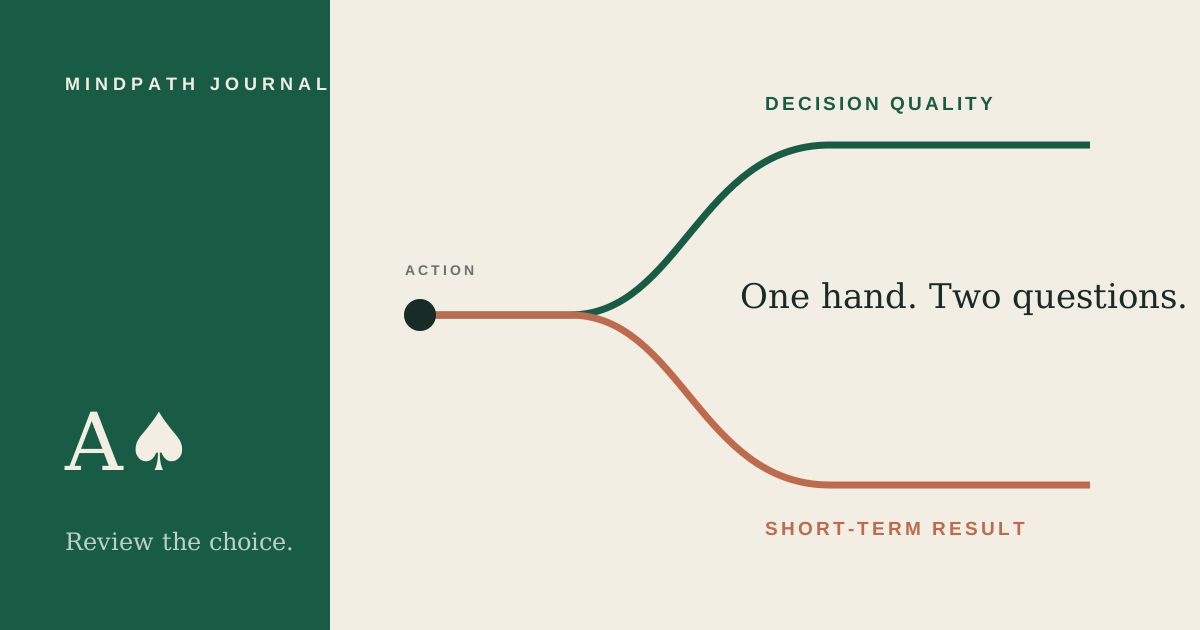
If the river can rewrite your opinion of the turn, the result is doing analysis that belongs to evidence. Separate the two before the next hand begins.
THE RESET
- Freeze the information available at decision time
- Grade the process before revealing the result
- Treat emotion as data, not a verdict
The river is new information. It was not available when you acted on the turn. Letting that card grade the earlier choice is emotionally understandable and analytically wrong.
Freeze the decision in time
Reconstruct the hand only up to the moment you had to act. Write down position, stack depth, action, timing, opponent tendencies, your range estimate and the options you considered. Then hide the later cards.
Ask four questions: What did I know? What did I reasonably infer? Which options were available? What trade-off did I choose? That is the evidence the decision can fairly be judged on.
Separate technical error from emotional pain
A good call can lose. A poor bluff can get through. Neither outcome changes the process that produced it. The first may hurt while remaining technically sound; the second may feel brilliant while still being a mistake worth correcting.
This is why self-worth cannot ride on a short sample of cards. Your task is not to prove that you deserved the pot. Your task is to keep the mind stable enough to make the next decision with the same care.
Use a two-pass review
Pass one happens during the session: mark the hand, name the emotion and return attention to the table. Do not prosecute the case while your body is still reacting.
Pass two happens later: compare the decision with ranges, combinatorics, pot odds, solver work or a trusted discussion partner. Write a one-sentence verdict that does not mention the result: “Given this range and sizing, calling was profitable,” or “I ignored the strongest part of the river range.”
The path forward
Discipline is not feeling nothing. It is refusing to let a feeling seize control of the grading system. Capture the pain, review the evidence and keep your identity larger than the last hand.
REFLECTIONS
Questions to carry forward
What does resulting mean in poker?
Resulting is judging the quality of a decision mainly by whether the hand won or lost, instead of by the information and reasoning available when the choice was made.
Should I review a painful hand immediately?
Capture the hand immediately, but delay the technical verdict until your physical and emotional arousal has settled enough for an honest review.
NEXT PATHS
Build an Ontario Online Blackjack Session Plan Before You Play↗Poker Tilt Control Starts With the First Behaviour Change↗