
JOURNAL 002 · TILT CONTROL
Poker Tilt Control Starts With the First Behaviour Change
Do not wait to feel out of control. The first reliable warning is usually a change in pace, selection or self-talk that you can define before sitting down.
THE RESET
- Define normal behaviour before the session
- Treat two early warning signs as a mandatory pause
- Make chasing and abandoned limits automatic stop conditions
Poker tilt control starts when your behaviour first departs from your normal decision process. Waiting until you feel furious is too late if your clicking speed, calling range or reason for staying in the game changed ten hands earlier.
Research describes poker tilt as a loss of emotional regulation accompanied by cognitive distortion and weaker decisions. A study of online poker behaviour includes faster clicking and harder keyboard use among the observable manifestations. That matters because behaviour can be recorded; “I felt a bit off” cannot be applied consistently.
What Is Poker Tilt Control
Poker tilt control is a pre-committed response to evidence that emotion is changing your decisions. It is not the ability to feel calm through every loss.
The distinction removes an impossible standard. A bad beat can produce anger, disbelief or urgency without automatically destroying the next decision. Tilt begins when that state alters selection, sizing, pace or the ability to stop.
The objective is therefore behavioural consistency. You define what normal play looks like, identify the earliest departures and decide the response while your judgement is still clear.
Which Warning Signs Appear Before Full Tilt
Early warning signs are personal, but they must be observable. “Frustrated” is a feeling. “Opened two extra tables after losing a stack” is evidence.
Common candidates include:
- acting before completing the normal range check;
- clicking faster or with unusual force;
- widening calls because an opponent seems undeserving;
- narrating the session in recovery language such as needing to get even;
- abandoning table-selection standards;
- checking the cashier repeatedly between hands;
- extending the session past its planned end;
- moving stakes without following the bankroll rule.
Qualitative poker research links severe losses with disbelief, perceived unfairness and chasing behaviour intended to restore a fair balance. The sequence is useful because it exposes the transition from emotion to action.
How Does The Green Yellow Red Protocol Work
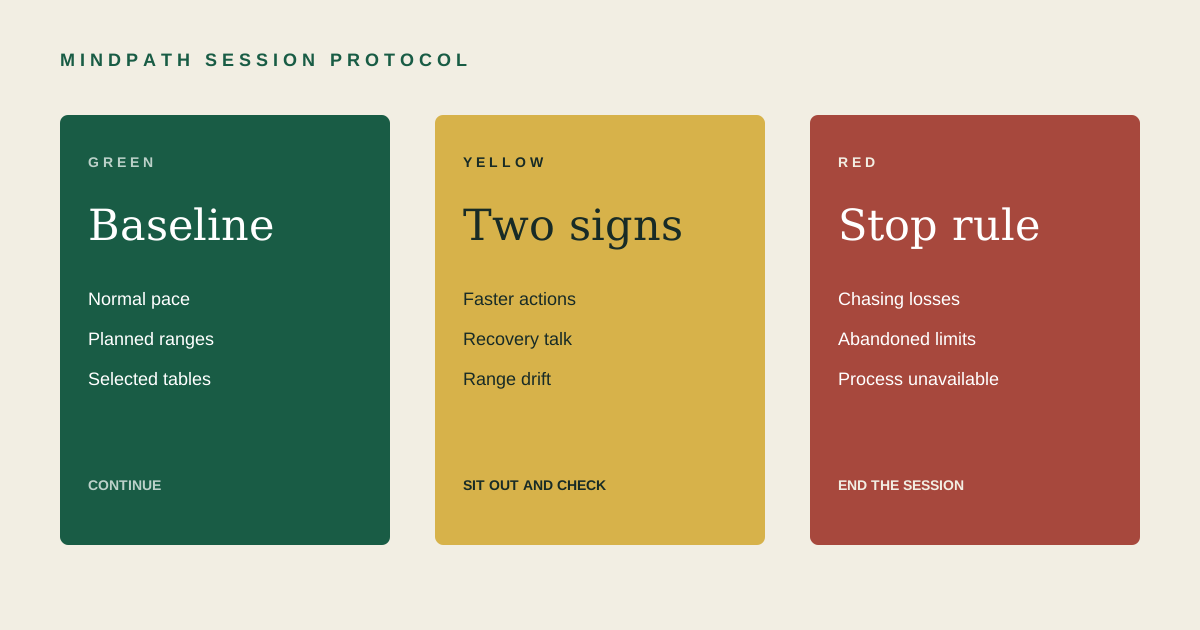
The protocol attaches a predetermined response to three states. Write it before opening a table.
| State | Evidence | Required response |
|---|---|---|
| Green | Normal pace, planned tables, range-first decisions | Continue and record marked hands |
| Yellow | Any two personal warning signs | Sit out, leave the screen and reassess |
| Red | Chasing, abandoned limits or inability to complete the decision routine | End the session |
The information gain is not the colour system. It is the threshold. “Pause when tilted” leaves the same emotional mind to decide whether it qualifies. “Pause when two listed behaviours occur” removes that negotiation.
What Should Happen During A Yellow Pause
A yellow pause should interrupt the decision environment rather than become another form of analysis. Sit out every table. Stand up. Record the trigger and the two behaviours that activated the rule.
Then answer three questions:
- Can I state the next hand’s decision process without mentioning the session result?
- Am I willing to make the same fold now that I would have made before the loss?
- Would I reopen these tables if my balance were hidden?
If any answer is no, the session is red. The point is not to persuade yourself to continue. It is to test whether the original process is available.
Momentarily leaving the game to cool down appears among the emotion-regulation strategies discussed in research on online poker and tilt. That supports the interruption, but it does not prove a specific number of minutes works for every player. Return only when the behavioural standard is restored.
Why Is A Financial Stop Loss Not Enough
A stop loss controls money exposure, while a behavioural stop controls decision quality. They overlap but do different jobs.
A player can make poor recovery-driven decisions before reaching a two-buy-in stop. Another can lose the same amount through well-played hands without showing any decision drift. The money line is still valuable because it limits the session, but it cannot diagnose the process on its own.
Use both: a hard financial boundary and a behavioural red line. Neither should be raised during play.
How Should A Tilted Session Be Reviewed
Capture first and judge later. Save the relevant hands, the trigger and the first observable behaviour change. Technical review begins only when the result no longer feels like a problem the next hand must solve.
Review the earliest changed decision, not merely the largest pot. That hand identifies the beginning of the leak. Our framework for separating a good poker decision from a bad result keeps the later card from rewriting the evidence available at the time.
The final note should be operational: “After the first fast call and recovery thought, I will sit out all tables.” That can be used in the next session. “Do not tilt” cannot.
The MindPath Journal treats mental-game strategy as a collection of repeatable decisions. If tilt repeatedly defeats the stop rules, or gambling is creating financial pressure, secrecy or distress, stop playing and use professional or provincial gambling support.
REFLECTIONS
Questions to carry forward
What is the earliest sign of poker tilt?
It differs by player, but a measurable change in action speed, range discipline, table selection or recovery-focused self-talk is more useful than waiting for anger to become intense.
Can a stop loss prevent poker tilt?
A financial stop can limit damage, but it does not detect every form of tilt. Behavioural stop conditions catch poor decision-making that can appear before the money threshold is reached.
Should I review a tilted session immediately?
Save the hand histories and note the trigger immediately. Delay technical judgement until your emotional and physical state is stable enough to review the decisions without trying to recover the result.
References
Tilt in Online Poker Loss of Control and Gambling Disorder · International Journal of Environmental Research and Public Health
Sleep or Play Online Poker · Nature and Science of Sleep
This is just so unfair · International Gambling Studies
NEXT PATHS
A Good Poker Decision Can Still Produce a Bad Result↗Build an Ontario Online Blackjack Session Plan Before You Play↗